Cars II - From auto-free to auto-fee
Hallelujah! Congestion pricing came, at last, to New York City, at the stroke of midnight on Saturday Jan. 4 (more precisely, midnight plus one second on Sunday Jan. 5, 2025).
Here's what it looked like, a few hundred feet downstream from one of the congestion-zone entry points, on Lexington Ave. between 60th and 59th Streets:
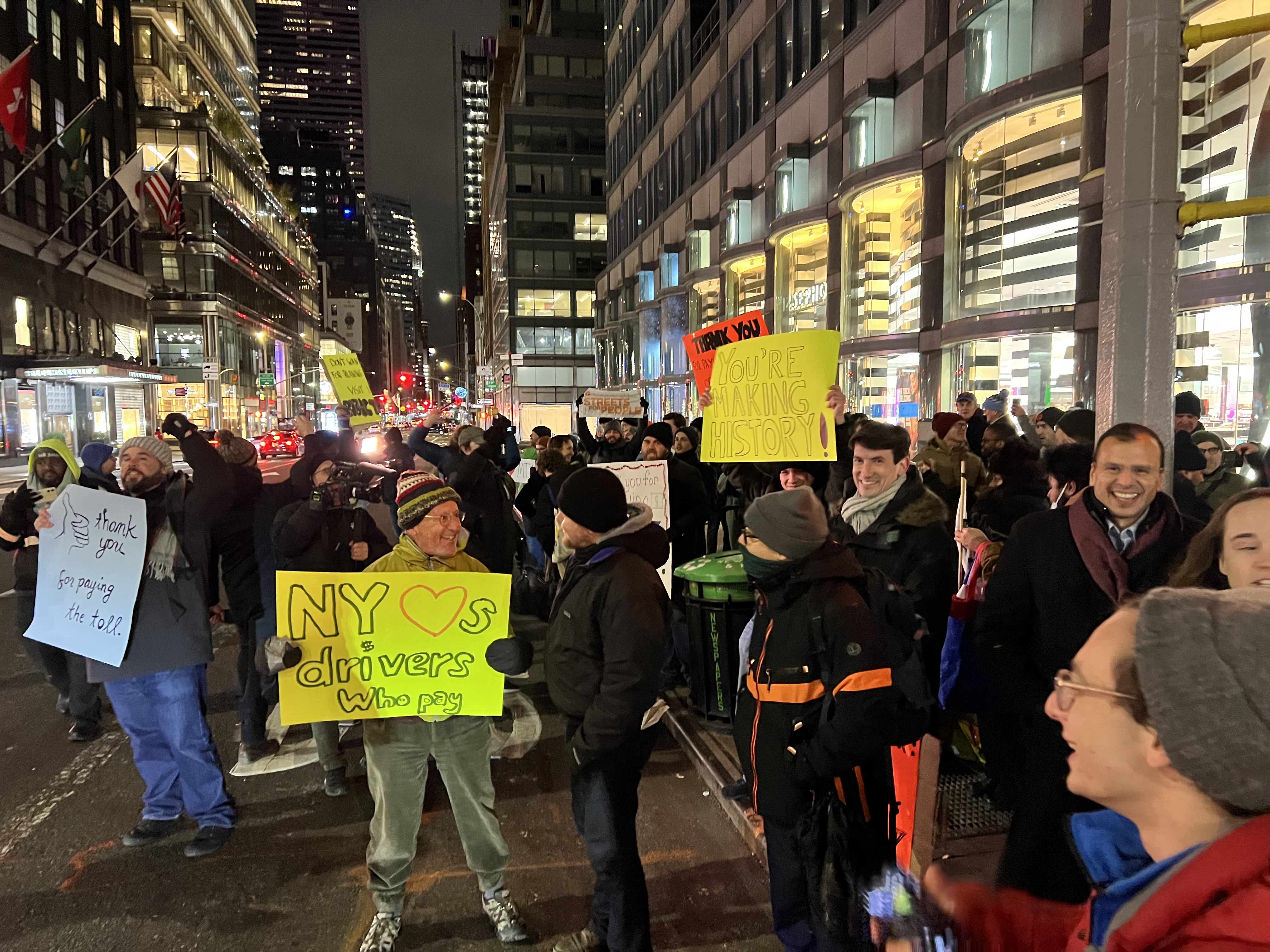
(I'm in the foreground left of center, in wool hat, holding the bright yellow sign and talking to my compatriot and friend Christopher Ketcham.)
For a sense of what it felt like to me and others to finally push NYC's congestion pricing program across the goal line, read my essay Strangers Not Strangers: How I Greeted the Start of Congestion Pricing, which I posted to Streetsblog later that day.
The same photo leads my Washington Spectator post Defending Congestion Pricing, written and posted a month later. It's the third in my trilogy of Spectator posts over the past year tracing the twists and turns that led, finally, to the program's start on that early January night.
The flip of the switch came seven months to the day after NY Gov. Kathy Hochul blew up New York City's transit and traffic hopes by "indefinitely pausing" the June 30 start of the congestion pricing program that the state legislature mandated in 2019 and which was shaped and finalized during her first thousand days as the state's chief executive. Hochul's bolt from the blue threatened not just the work of legions of agencies and advocates but her own political viability, as I reported in my June 11 (2024) broadside for the Washington Spectator, Hochul Murder Mystery.
"Mystery" didn't enumerate congestion pricing's benefits for New York and the region; I and others have done so endlessly, including in my nearly 100 Streetsblog posts on congestion pricing (download the pdf list, or Page Down for other examples). Rather, it explained why Hochul's betrayal set off such widespread resistance, how congestion pricing was "built into expectations for transit, traffic and the health of the city that could not be easily unraveled," and why the story wouldn't fade. And, most importantly, why I was convinced Hochul's bid to block congestion pricing would fail.
Happily, I and my fellow advocates were right. Shortly after the Nov. 5 election, Hochul unveiled a scaled-down but still robust version of the plan she had scuttled on June 5 and resolutely stayed the course, leaving the MTA free to turn on the tolls on Jan. 5. My February Spectator post relates how and why, though the decades-long push is fully described in my January Spectator article, "Diary of a Transit Miracle" (see link near the top of the "History" section further below).
At this writing (late March 2025), vehicle volumes appear to be down in almost all traffic corridors since Jan. 5, though real-world complexities such as the "rebound effect" make it far too soon to draw definitive conclusions, as I wrote in mid-January in Why I’m Not Scrutinizing Traffic Data Yet (It’s The Rebound Effect, Stupid). An illuminating take on the early data was a Jan. 17 analysis by a team at Bloomberg News, Is NYC’s Congestion Pricing Working? Fewer Private Cars Are On the Road (For Now). I'm quoted but can't take credit for the team's brilliant stroke of "imaging" every vehicle driven past the company's Lexington Ave. HQ just inside the zone and tracking their make, model and year to conclude that, contrary to some negative expectations, congestion pricing has not shifted the mix of cars toward the wealthy.
Some History
Pursuant to state legislation enacted in March 2019, the tolls must raise at least $1 billion a year in net revenue, 80% of which was pledged to support NYC Transit's capital program to modernize the city's subways and buses operated by NYC Transit, with the other 20% committed to parallel investments in the MTA's two commuter railroads -- the Long Island Rail Road and Metro-North Railroad.
How the legislation came to be is narrated in my Washington Spectator essay, Diary of a Transit Miracle, which recounts the half-a-century long effort to define, scope, build public support for, enact and ultimately implement this revolutionary program. "The miracle," I wrote then, "is three-fold: Winners will vastly outnumber losers; New York will be made healthier, calmer and more prosperous; and that this salutary measure is happening at all, after a half-century of setbacks."
That essay covered the familiar ground of Mayor Bloomberg's unsuccessful 2007-2008 attempt to enact congestion pricing and the passing of the congestion pricing torch from former NY Gov. Andrew Cuomo to his successor, Kathy Hochul. But it was built around a fresh narrative in which Mayor John Lindsay and two like-minded "civic titans" -- attorney Ted Kheel and economist Bill Vickrey -- devised and fought for a package of motorist tolls and charges to keep the transit fare from climbing to 30 cents from 20 cents. That effort, I argued, marked the true start of congestion pricing discourse and campaigning. It was memorialized in a remarkable 27-minute video of the trio's Dec. 1969 City Hall press conference, which may be viewed via a link in my Washington Spectator post.
My article also complimented and congratulated Gov. Hochul for championing congestion pricing after Cuomo resigned his position in August 2021. Hochul and MTA CEO Janno Lieber hadn't merely moved the process along, I wrote. They consistently backed the program to the hilt in public appearances, media interviews and political arm-twisting. A good glimpse of Gov. Hochul's full-throated support of congestion pricing was her remarks at a Dec. 5, 2023 rally in Manhattan's Union Square. (I followed the governor at the podium.)
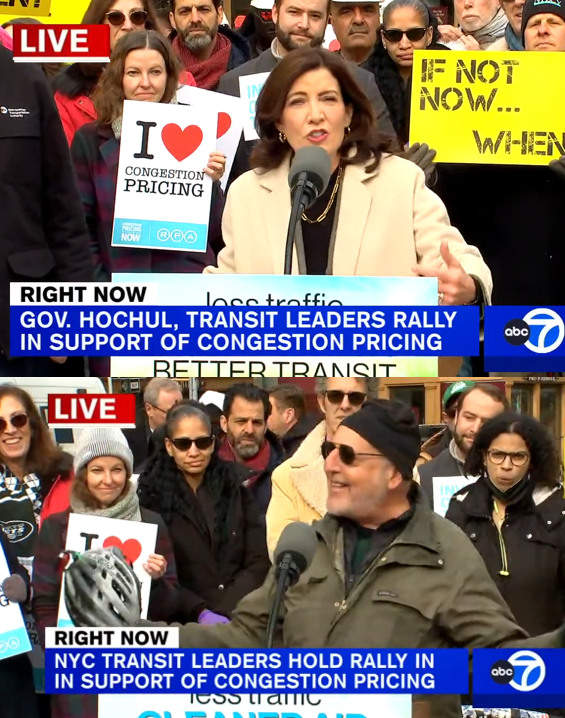
[Click here to watch/hear Gov. Hochul’s remarks depicted above. Click here for mine.]
The start of congestion pricing, I wrote, would be groundbreaking, not just bringing NYC in step with London, Stockholm and Singapore as world cities with large-scale congestion tolling, but also signaling a willingness in the United States to replace unbridled motordom with enlightened governance. This was to be a huge win for NY-area transit advocates whose relentless campaigning for revitalized mass transit in general and congestion pricing in particular compelled Cuomo in August 2017 to declare that "Congestion pricing is an idea whose time has come" and to wield his political acumen and muscle over the ensuing 18 months, culminating in enactment of the enabling legislation in March 2019.
My role in winning congestion pricing for New York City
I'm proud to claim a bit of credit for winning congestion pricing -- as a principal in the Move NY Campaign (alongside traffic guru "Gridlock" Sam Schwartz and organizer-strategist Alex Matthiessen), as a congestion pricing tribune with some 80 posts explicating and supporting congestion pricing in StreetsblogNYC and guest essays in the New York Times and other outlets, and as traffic modeler.
From Autumn 2017 to early 2019 the governor's staff deployed my "Balanced Transportation Analyzer" spreadsheet (further discussion + link are below) to scope congestion pricing by estimating how different toll levels would affect revenue generation, traffic-flow improvements and other benefits from the toll program. (The Fix NYC Advisory Panel Report, Appendix B, includes a glowing acknowledgment of the BTA's power, utility and ease of use, and of its central role in the advisory panel's work.)
As well, the BTA enabled the transit advocacy community to wield its own analyses and speak with authority in arguing for congestion pricing as the most efficient and equitable policy for creating a new transit revenue stream and reducing Manhattan gridlock. This capacity was unique to NYC's congestion pricing campaign; no other group of advocates in the world has had our (and my) ability to quantify and frame congestion pricing's benefits and to influence the eventual toll plan design.
The Balanced Transportation Analyzer spreadsheet model
My work developing the BTA model and analyzing and advocating equitable and effective traffic-pricing plans for New York City was shaped and supported by the Nurture Nature Foundation, a philanthropy established and guided by the late Theodore W. Kheel and carried on by his family. Ted inspired and enabled me, through extraordinarily generous finanical support, to develop the Balanced Transportation Analyzer (the name was his invention).
The BTA's 100-odd tabs and 160,000 equations not only enable the user to model different congestion toll levels; they also calculate impacts on carbon and other tailpipe emissions, prospective increases in subway and bus ridership and a myriad of other benefits from (and costs of) congestion pricing in NYC. The BTA spreadsheet may be downloaded by clicking here.
Scintillating and accessible accounts of the BTA have been published in New York magazine, Motherboard/Vice, Traffic Technology International, and Wired. They're all terrifically entertaining. In Nov. 2023 those pieces were joined by journalist Annie Lowery's penetrating and richly humored story Maybe Don't Drive Into Manhattan: The Real Cost of All This Traffic.
My personal favorite among these pieces is the Wired article, which profiled both me and Ted Kheel, and which first brought the BTA to prominence. Here are links to each, in reverse chronological order:
* Why You Should Be in Favor of Congestion Pricing in New York, New York magazine (March 27, 2018).
* Meet the Spreadsheet That Can Solve NYC Transit (and the Man Who Made It), Motherboard/Vice (2017).
* Transport economist Charles Komanoff is determined to solve NYC's traffic problems, Traffic Technology International (2013).
* The Man Who Could Unsnarl Manhattan Traffic, Wired (2010).
My recent (2022-2024) articles and other publications on NYC congestion pricing
On July 17, 2023, the Nurture Nature Foundation released A Congestion Toll New York Can Live With, a report by Columbia Business School climate-economist Gernot Wagner and myself, laying out the key elements of and rationale for the congestion pricing plan we felt would best achieve the city and regional imperative of reducing motor vehicle traffic and re-invigorating mass transit. That report outlined a $15/$9/$3 toll structure for private cars entering the Manhattan Congestion Zone, which, coupled with a proposed additional surcharge of $2.25 for Uber and Lyft cars touching that zone, would, we estimated, raise $1.2 billion a year in new net revenue, easily meeting the 2019 state legislative mandate to fund $15 billion in new mass transit investment.
Four months later, on Nov. 30, 2023, the state-city Traffic Mobility Review Board released its toll recommendations, and they were uncannily close to Gernot's and my July 2023 proposals. You can download the TMRB's report here, and you can read my spin on it in my Streetsblog post, IMHO, TMRB is A-OK. In early December 2023 the MTA board approved the TMRB's recommendations for public comment, and it is that toll design that the board ratified on March 27, 2024.
Gernot (Wagner) and I presaged our July 2023 report with a June 8, 2023 guest op-ed essay in The New York Times, There's Only One Way to Fix New York's Traffic Gridlock. That essay anticipated and responded to most of the doubts and concerns about congestion pricing being raised as its implementation drew nearer. Any congestion pricing supporter looking for big-picture arguments in support of tolling vehicle trips into the heart of Manhattan should read it.
Two other essays of mine deserve note.
On the eve of the MTA board's final congestion pricing up-vote, on March 26, 2024, Streetsblog published Here’s Why the MTA Board Should Proudly Approve Congestion Pricing, a post in which I explained how an inadvertent and obscure error in the MTA's congestion model led to widespread but unfounded worries that congestion pricing could cause car and truck trips to "divert" around Manhattan. The truth, I argued, is that congestion pricing will cut traffic volumes, tie-ups and pollution in virtually every nook and cranny of New York City and the surrounding region.
Earlier, in February 2024, I published Support the Fight for Congestion Pricing in NYC. This longish essay, posted in the labor news site "Work Bites," pushed back against what I viewed as narrow and self-serving objections to congestion pricing from out-of-touch union officials and also served as a cri de coeur on behalf of the hundreds of transit advocates who had fought for congestion pricing for too long and too many good reasons to turn back now.
Other posts and reports on traffic and road pricing
Released Nov 6, 2023: My affidavit for the New York Taxi Workers Alliance supporting their Article 78 petition to compel the NY Taxi & Limousine Commission to conduct an environmental review of its October decision to lift the cap on the number of "ride-hail" (Uber and Lyft) vehicles permitted to operate in New York City, so long as the additional vehicles are electric (battery) powered. Relying on my Balanced Transportation Analyzer Excel model, my affidavit demonstrates that the incremental slowdown of traffic due to the increased number of vehicles, both in the Manhattan core and throughout the city and region, is likely to result in substantial increases in emissions of climate-damaging carbon dioxide and health-damaging fine particulates. Download the 9-page pdf via this link.
"Bicycle food-delivery in New York City is broken, not just because it’s essentially unregulated, but also because it’s unpriced," I wrote in a 2023 post for StreetsblogNYC , Want Safe Batteries? Stop Pretending Food Delivery is Free. "Failure to price deliveries by distance leads New Yorkers to order from three miles away even though three blocks might suffice. The result is lots of unnecessary e-bike miles and excessive battery charging, whose costs are only now being confronted." Strangely, none of NYC's safer-streets and bicycling-advocacy organizations have mentioned even once that post's idea of disincentivizing New Yorkers from ordering faraway delivery by charging the app-based food-delivery services (Uber Eats, DoorDash, Grubhub) a dollar for each "extra" delivery-mile beyond a one-mile radius. (The revenues would be applied to a City fund to pay for safe ebike batteries and storefront facilities for deliveristas.)
The MTA's 46-volume environmental assessment of congestion pricing, released in August 2022 as part of the protracted federal review of the long-awaited Manhattan central business district toll plan, is "an own goal of monstrous proportions," I argued in MTA Must Fix Its Defective Assessment of Congestion Pricing, published on Sept 28, 2022, in Gotham Gazette. In this 3,000-word post, I showed that in its assessment the MTA understated by five-fold the likely reductions in automobile traffic outside the Manhattan core, leading to unfounded but politically damaging criticism that congestion pricing is just a money grab that will benefit wealthy Manhattan residents while disadvantaging drivers from the rest of the city and region. This post too is essential reading for anyone seeking to understand and refute criticisms of New York's congestion pricing effort.
On Sept 1, 2022 I submitted a brief (2-p.) statement to the MTA regarding their environmental assessment of congestion pricing. The statement is entirely devoted "to a matter that appears to have gone unmentioned in the EA and in the thousands of responding statements and comments, despite its being a foundation stone on which congestion pricing rests: establishing the extent to which an additional auto trip into the congestion zone slows down other vehicles occupying the same streets and roads — both en route to the zone as well as inside it."
On Nov. 23, 2021, the New York City Council released my report, "Taming New York City’s E-Delivery Gridlock: Time-Based Charges for Street Space." The report proposes charging package delivery vehicles (such as those operated by Amazon, UPS and FedEx) a per-minute charge for the time they occupy the City’s most congested streets and curb spaces.
The report estimates that travel delays caused by delivery trucks occupying road and curb space while delivering e-commerce parcels cost New Yorkers time worth more than $400 million annually. The delivery vehicle charges would initially apply only in Manhattan and adjacent sections of Brooklyn, Queens and the Bronx with the city’s highest population and traffic densities.
Click here to download the full report.
In January, 2021, the New York City Council released my report, "Curbing For-Hire Vehicle Stockpiling in the Manhattan Core: Empty-Vehicle Charges for Ride-Hail Companies." The report, commissioned by the council in mid-2019, was completed in early 2020 but was held back for nearly a year, due to the Covid pandemic and lockdown.
It recommends charging Uber and Lyft 11 cents for each minute their affiliated vehicles are occupying the Manhattan taxi zone (south of 96th Street), M-F 6am-8pm, and half that amount, 5.5 cents, at other times.
Click here for a brief Q&A about the report and its recommendations. Click here to download the full report. The executive summary and full report may also be viewed at and downloaded from the City Council's Web site, via this link.
A July 2021 post in Streetsblog, Congestion Pricing Delay Could Cost New Yorkers 27,654 Years of Their Lives, by journalist Christopher Robbins, drew heavily on my BTA model to portray quantitatively the enormous costs in time and health from Cuomo's apparent hold on implementing congestion pricing.
In March 2019, with renowned political organizer Jeff Blum, I published Congestion Pricing Is New York's Green New Deal in The Nation magazine. The subtitle, "Charging drivers in NYC could help fix the subways, fight climate change, and reduce inequality" summarizes our thrust; the article itself is a great read.
A history of how congestion pricing came to pass in 2019 is yet to be written. As well, the final form of the congestion charging system won't be announced until late 2021 or early 2022. In the interim, you may want to download the concise (7 slides) PowerPoint presentation, "NYC Congestion Pricing," that I presented at an international energy-efficiency symposium in Washington, DC in June, 2018. Click here.
Also of interest, from December, 2017, is: "London Traffic Would Be At Least 20 Percent Slower Without Congestion Pricing" explains why congestion charging in London has been a resounding success. 8 pages, illustrated. Click here.
In December 2013, I addressed China's inaugural public forum on congestion pricing, held in Hangzhou. I reported on it here for Streetsblog. Along with representatives from London, Stockholm, Milan and Singapore, I was asked to write an account of New York City's political experience with congestion pricing, for publication in a Chinese-language volume issued in 2014. My 19-page narrative, Congestion Pricing for New York City, is available here.
A pdf of my March 7, 2012 presentation at New York University Law School's Milbank Tweed Forum, "How NYC Is Breaking The Gridlock On Transportation Policy," is available here.
My 16-page report from early 2012 arguing that the planned 15-lane replacement Tappan Zee Bridge will cost too much to be financed solely through tolls on bridge users.
A 10-page report supporting my Jan. 2012 Reuters op-ed on the traffic impacts of adding 2,000 medallion taxicabs to NYC's yellow-cab fleet.
Is congestion pricing economically (and politically) regressive or progressive? I argued the latter in this spirited Nov. 2011 letter to a prominent socialist author-activist.
Will congestion pricing harm or help lower Manhattan? I argued the latter (resoundingly!) in this op-ed, Why downtown should back congestion pricing, published in The Villager newspaper on Feb. 8, 2018.
Since 2008 I've published over 90 articles on congestion pricing, spotlighting my traffic-pricing modeling, on the NYC livable-streets news source Streetsblog. This link goes to a pdf list of all of these posts.
This link goes to a pdf list of my more than 250 Streetsblog posts (with subjects ranging from congestion pricing and traffic modeling to helicopter noise and traffic violence from 2006 to the present).
Following are direct links to a dozen or so of my Streetsblog posts on congestion pricing and traffic modeling:
♦April 3, 2020, Coronavirus Will Go Away, Congestion Pricing Must Not
♦March 6, 2020,
Relinquishing Congestion Pricing Exemptions Fantasies
♦ March 28, 2019,
Congestion Pricing Carveouts Will Steal Millions of Hours and Billions of Bucks
♦ March 21, 2019,
Congestion Pricing Will NOT Fill Upper Manhattan With Suburbanites Cruising for Parking
♦ March 18, 2019,
Investing Congestion Revenues in Better Train Signals Could Save New Yorkers Lots of Time
♦ February 12, 2019,
How to Counter the Latest Congestion Pricing Objections
♦ January 16, 2019,
Good Tidings for Congestion Pricing From Governor Cuomo
♦ May 29, 2018,
Eight Reasons Why Congestion Pricing Goes Great With the Fast Forward Plan to Fix NYC Transit
♦ April 10, 2018,
Setting Up a Cordon Toll Would Pay for Itself in a Few Months
♦ March 7, 2018,
An Hourly Fee on Cabs and Ubers Is Less Radical Than It Appears
♦ January 12, 2018
Congestion Pricing Will Help Stop Climate Change -- But Differently Than You Think
♦ January 2, 2018,
Why Congestion Pricing Won't Overwhelm the Subways
♦ December 5, 2017
London Traffic Would Be At Least 20 Percent Slower Without Congestion Pricing
And here are links to some much-earlier ones:
♦ August 1, 2011: Guess Who Has a Lot to Lose from an MTA Meltdown: Drivers
♦ March 18, 2010: In Any Language, the Cost of Congestion Comes Through Loud and Clear
♦ January 6, 2010: With Congestion Pricing, Saving Time Trumps Reducing Pollution
♦ October 16, 2009: Wanted: Crowd-Sourced Transportation Analysis
♦ October 13, 2009: Paradox, Schmaradox. Congestion Pricing Works.
I also published these pieces in Grist in 2007-08, on larger meanings in the political battle over
congestion pricing:
♦ April 8, 2008:
Machiavelli Meets The Big Apple: Ten Reasons NYC's Congestion Pricing Plan Went Belly Up
♦ March 31,
2008: High Noon for Congestion Pricing: What We Lose if Bloomberg's Plan Goes Down
♦ July 16, 2007:
Valuing The Commons: Congestion Pricing's Hidden Payoff
The following articles trace the lineage of my traffic-pricing work to Theodore (Ted) Kheel:
♦ Feb. 11, 2008:
A Climate for Old Men: Spearheading Transit for Livable Cities at 93 (in Grist)
♦ Nov. 15, 2010: In Memoriam: Ted Kheel, Transit
Advocate and Visionary (in Streetsblog)
♦ Nov. 19, 2010:
Requiem for Man Whose Ideas on Transit Aren't Past (by Clyde Haberman, in The New York Times)
Other articles and papers on traffic pricing
My August 2006 op-ed in Seattle Post-Intelligencer,
"Forward-Thinking Idea for a Trendsetter," posing "parking cash-out" incentives as an alternative to a Microsoft mega-parking lot.
My March 2003 op-ed in the
Daily News arguing the fairness of East River bridge tolls
My 2003 report, "A Value-Pricing Plan for the MTA" (PDF)
My 1997 report for Energy Foundation, "Environmental Consequences
of Road Pricing"
My Oct 2001 op-ed in Newsday, "Giuliani puts brakes on car culture"
Two for Vickrey -- my portraits of road-pricing
pioneer (and Nobel laureate) Bill Vickrey in the NY Daily News, "The Man Who Had A Cure for Gridlock" (Nov 1996),
and New York magazine, "Traffic: Demand and Supply" (Dec 1996)
My 1995 Newsday op-ed, "Should the L.I.E Become a Toll Road?" (with June 2006 intro)
Pollution Taxes for Roadway Transportation: My extensive (40-page) article in the Pace Environmental Law Review (Vol. 12, Issue 1, Fall 1994)
outlining a mix of fees, charges and taxes that would internalize most of the unpriced costs of driving.
Article
summarizing "Pollution Taxes" law review article.
Crossroads: Highway-Finance Subsidies in New Jersey, 1995 report
for the Tri-State Transportation Campaign by Charles Komanoff & Margaret Sikowitz, establishing that driver tolls, taxes and tickets in New Jersey
account for only 77 cents of each dollar spent to build, maintain, repair and operate the state's highways and roads.
Subsidies for Traffic: How Taxpayer Dollars Underwrite Driving in New
York State, 1994 report for the Tri-State Transportation Campaign by Cora Roelofs & Charles Komanoff, establishing that driver tolls, taxes and tickets in New York
State account for only 65 cents of each dollar spent to build, maintain, repair and operate the state's highways and roads.
More
| Home | |
| Bio (PDF) | |
| Areas of Expertise | |
| Recent Media Coverage |
